

OpenAI LLM analytics installation
Contents
- 1
Install dependencies
RequiredFull working examplesSee the complete Node.js and Python examples on GitHub. If you're using the PostHog SDK wrapper instead of OpenTelemetry, see the Node.js wrapper and Python wrapper examples.
Install the OpenTelemetry SDK, the OpenAI instrumentation, and the OpenAI SDK.
- 2
Set up OpenTelemetry tracing
RequiredConfigure OpenTelemetry to auto-instrument OpenAI SDK calls and export traces to PostHog. PostHog converts
gen_ai.*spans into$ai_generationevents automatically. - 3
Call OpenAI LLMs
RequiredNow, when you use the OpenAI SDK to call OpenAI, PostHog automatically captures
$ai_generationevents via the OpenTelemetry instrumentation.Note: If you want to capture LLM events anonymously, omit the
posthog.distinct_idresource attribute. See our docs on anonymous vs identified events to learn more.You can expect captured
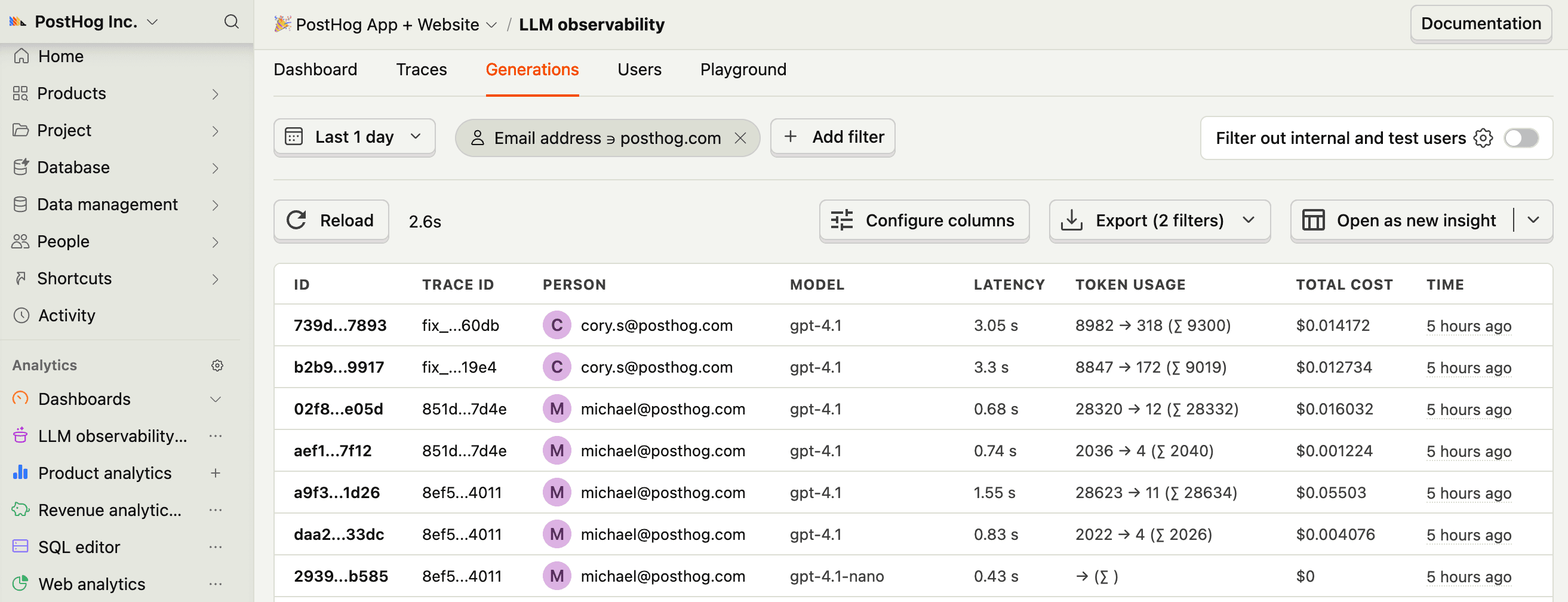
$ai_generationevents to have the following properties: - 4
Capture embeddings
OptionalPostHog can also capture embedding generations as
$ai_embeddingevents. The OpenTelemetry instrumentation automatically captures these when you use the embeddings API: - 5
Next steps
RecommendedNow that you're capturing AI conversations, continue with the resources below to learn what else LLM Analytics enables within the PostHog platform.
Resource Description Basics Learn the basics of how LLM calls become events in PostHog. Generations Read about the $ai_generationevent and its properties.Traces Explore the trace hierarchy and how to use it to debug LLM calls. Spans Review spans and their role in representing individual operations. Anaylze LLM performance Learn how to create dashboards to analyze LLM performance.